
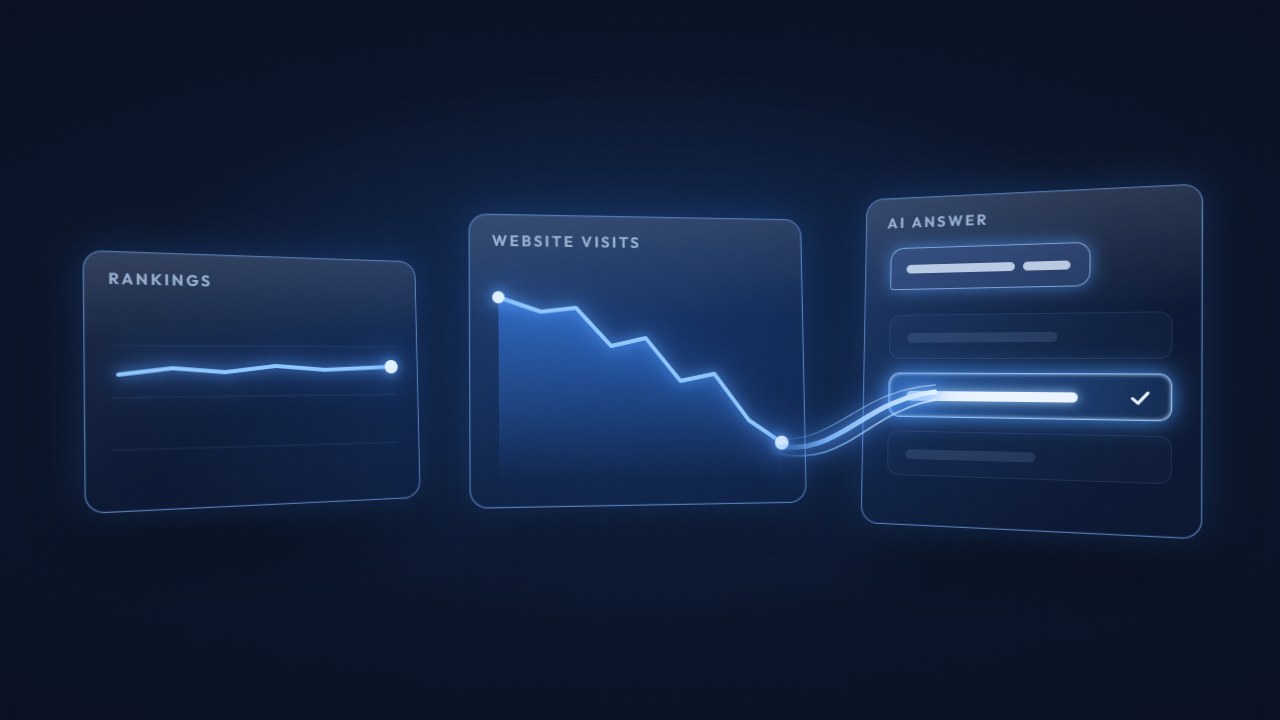
Your Google rankings look the same as they did last year, but your website traffic is down. You ask your web person what changed, and nobody can point to anything that broke.
What local owners keep telling us
Owners keep telling us their website traffic is down. They understand that it matters whether AI assistants mention their business, but they don't know how to improve where they stand.
Before building AltisAI, our team ran an SEO and web department. We watched AI search grow and saw businesses lose out when AI didn't mention them. If your rankings haven't moved, your SEO may be fine. What may have changed is how some customers find a tradesperson in the first place.
Rule out the usual suspects first
Before blaming AI, check the ordinary causes:
- Season. Heating and cooling demand rises and falls through the year.
- Tracking. A change to your analytics setup can make traffic look lower than it is.
- Your Google Business Profile. A drop in your map position means fewer visits.
- Your site. A redesign or broken pages can quietly cost you visits.
- Calls from your listing. People who tap "call" on your Google listing never visit your website.
One question, one answer
Here's a question a homeowner might type into ChatGPT: "Who should I call for AC repair in Nanaimo BC?"
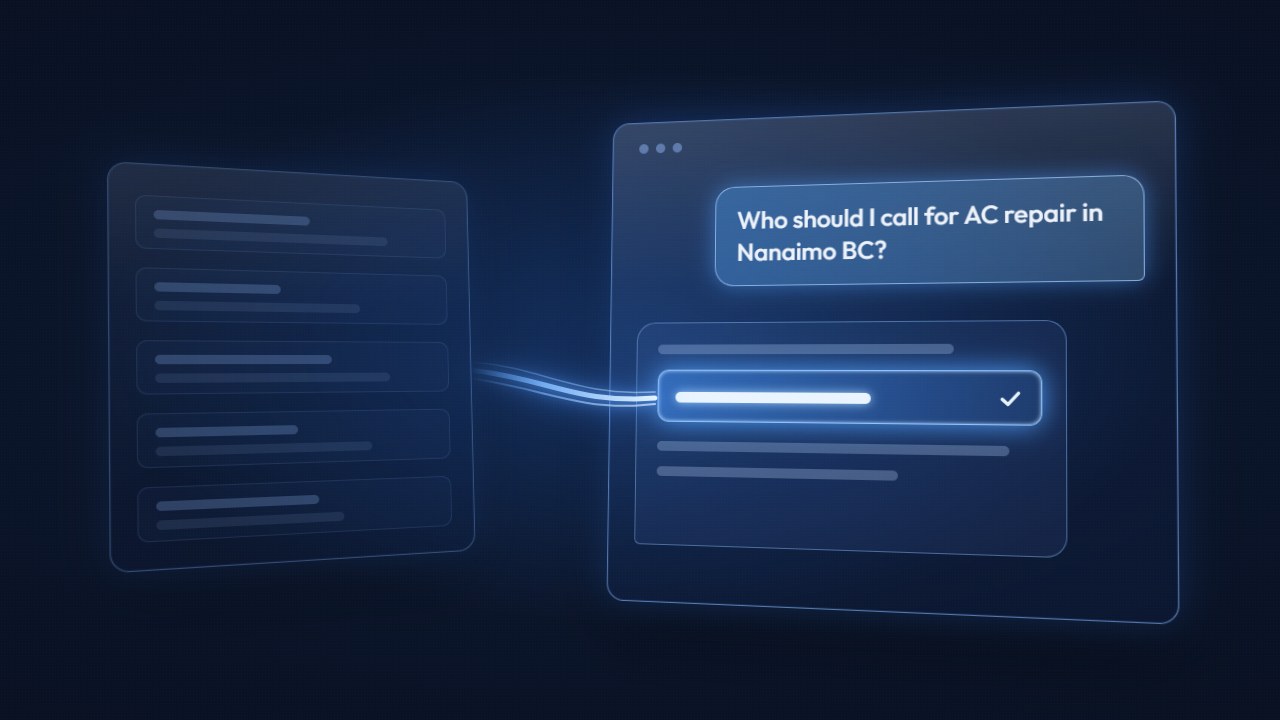
The assistant answers and names a business. There's no list of websites to compare, so the homeowner may never land on yours, even if you rank well on Google.
People also type full questions now, not two-word searches. A question like "Who can fix a ductless mini-split in Victoria before tonight?" gets a direct answer with a business named in it.
What we saw with a Nanaimo HVAC company
We tracked a Nanaimo HVAC company to see how this plays out. Its AI visibility score is a number out of 100 showing how often AI assistants recommend the business, compared with its competitors, across real customer-style questions.
| Date | AI visibility score |
|---|---|
| May 21 | 2%, then 3% |
| May 22 | 0%, then 32% |
| July 23 | 9.4% |
We looked at 20 local competitors. The top two held over 60% of AI citations (a citation is the AI naming or linking to a business in its answer). The company we tracked held about 8.5%. The full case study has more detail.
How AI assistants choose who to name
The audit showed why the leaders were picked:
- The top competitor offers 24-hour emergency service, and the AI cited that as a reason.
- Another was recognized for its customer service reputation and its specialty.
- A third was cited for heat-pump and central-AC expertise, backed by strong recent reviews.
These are the same things homeowners have always cared about. The AI reads them and passes them on.
There's a technical side too. The company scored 50 out of 100 for AI readiness, meaning how easy it is for AI tools to read and trust its website. It had schema (code on your site that tells search engines and AI tools what services you offer and where) and an llms.txt file (a plain text file that gives AI tools direct context about your business). It had no AI-specific rules in its robots.txt file, which tells automated readers what they may look at.
Why your score moves week to week
AI assistants refresh what they know regularly. A business recommended today might not be next month, with no change on its part. Nobody, us included, can guarantee a ranking or a mention in AI answers. That's why it helps to check more than once.
What to fix, in plain order
- Reviews. Ask for recent, real reviews that mention the work you did. Strong recent reviews backed one Nanaimo leader's citations.
- Listings. Keep your business name, phone, address and services the same everywhere you're listed, so AI isn't left guessing.
- Service and area pages. Have one clear page per main service and per area you cover. If you offer 24-hour service, say so plainly. That was the top Nanaimo competitor's edge.
- Schema and llms.txt. Ask your web person whether you already have them, and add them if not.
Check where you stand
The free way is to do it by hand: ask ChatGPT the question your customers would ask, for your trade and your town, and see who it names.
Our free scan does that check for you: 5 basic ChatGPT scans and an action plan, with no credit card. You don't need a website, just your business name, city and category.
ChatGPT is one assistant. To check all four (ChatGPT, Gemini, Claude and Perplexity), there are two paid options:
- A one-time Deep Audit, $199: 25 questions on each assistant, run twice (200 queries, under 5 minutes), including the exact pages the AI cited. No subscription.
- Pro, $29/month or $290/year: a Deep Audit every month plus a weekly 40-query check, so you can see your score move. It also shows which competitors get named and why, ties every task in your action plan to what the scan found, checks your website (schema, llms.txt, robots.txt) and includes a Google review playbook.
Run the free AltisAI scan at altisai.app to see whether ChatGPT names your business or a competitor when customers ask who to call.